I always feel so calm and relaxed when I am around a river, stream or waterfall, and water is a foundational theme in the Bible, appearing over 700 times from Genesis to Revelation, symbolising creation, judgment, cleansing, and spiritual life. It represents both physical necessity and divine sustenance, frequently used to describe God’s grace and the Holy Spirit.
In the beginning of the Bible, God transforms a desolate wilderness into a garden through a stream that waters the ground and brings life wherever it goes.
According to Biblical text and theological interpretation, God created the waters. While Genesis 1:2 describes the “waters” as being present in the deep before the dry land was separated, they are generally interpreted as being part of the initial creation of “the heavens and the earth” in Genesis
Here is how the creation of water is interpreted from the text:
- Created in the Beginning (Day 1): The “waters” in Genesis 1:2, over which the Spirit of God moved, are considered part of the initial creation of the universe out of nothing.
- Separation of Waters (Day 2): On the second day, God created the “expanse” (firmament/sky) to separate the waters above from the waters below, demonstrating his control and arrangement of the primordial elements.
- The Sea (Day 3): On the third day, God gathered the waters together to allow dry land to appear, naming the gathered waters “seas”.
Jesus clarifies that the living water is the Holy Spirit, which is given to those who believe in Him. In essence, the “living water” is Jesus’ offer of a permanent, inner, and life-giving relationship with God, overcoming spiritual emptiness and providing, in his words, “everlasting life”
The Spirit, like water in a desert, enables believers to grow and bear fruit, turning a “wasteland” of selfishness into a “well-watered garden”.
Water signifies the spiritual nourishment, renewal, and eternal life offered through accepting Jesus.
The blood and water that flowed from Jesus’ side after being pierced by a Roman soldier (John 19:34) hold both deep symbolic spiritual meaning and potential medical explanations. The event is primarily interpreted as a sign of Jesus’ true death and the release of divine life
Unlike water from a well (like Jacob’s well in John 4), which only provides temporary relief, the water Jesus gives creates an inward, permanent “fountain” that satisfies the soul forever
In John 4:14, Jesus tells the Samaritan woman that the water He provides will become in her “a spring of water welling up to eternal life”.
In John 7:38, Jesus says, “Whoever believes in me... rivers of living water will flow from within them,” indicating that the Holy Spirit within a believer will bless others.
Jesus’ first miracle was turning water into wine at a wedding in Cana in Galilee
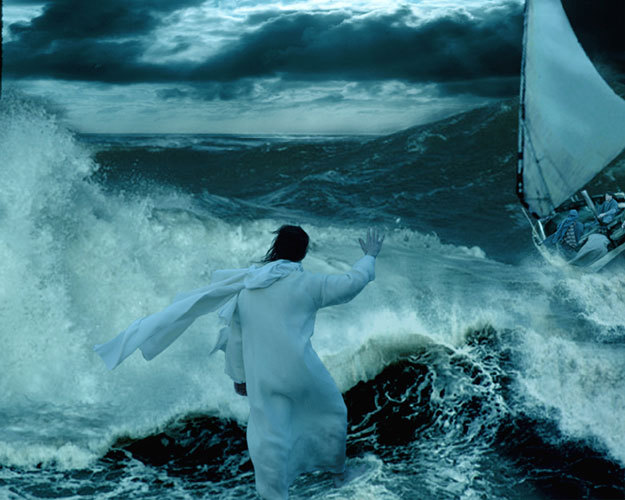
Jesus walking on water is a significant miracle recorded in Matthew 14, Mark 6, and John 6, occurring after he fed 5,000 people. Jesus walked on the Sea of Galilee during a storm to reach his disciples’ boat, calming their fears and exhibiting power over nature. Peter briefly walked on water before doubting, highlighting themes of faith.
Peter requested to walk out on the water. While initially successful, Peter grew afraid of the wind, began to sink, and was saved by Jesus, who questioned his doubt.
In the Bible, water baptism is a significant outward, public demonstration of an inward, personal faith in Jesus Christ. It serves as a symbolic act, marking a believer’s identification with the death, burial, and resurrection of Jesus.
Baptism represents dying to an old life of sin and rising to a new life in Christ. As a person is immersed in water, it symbolises burial with Christ, and as they come out, it symbolises resurrection to a new life, as detailed in (Romans 6:3-4) and (Colossians 2:12)
Parting the Red Sea (Exodus 14): Water acts as a tool of deliverance, allowing the Israelites to escape Egypt, and a tool of judgment against the Egyptians.
Water from the Rock (Exodus 17): God provides water for the Israelites in the desert, symbolising His care for His people in desolate times.
God flooded the earth with water
The biblical account of God and the flood, primarily detailed in Genesis 6–9, is a narrative of divine judgment, preservation, and a new covenant. God sends the flood to cleanse the earth of intense, widespread evil and violence, essentially reversing creation back to a state of chaos before restoring it through Noah.
The relationship between demons and water is a prominent theme in religious, mythological, and folklore traditions, often highlighting water as a force of purification, a barrier, or a domain for specific types of evil spirits.
Demons ask to be cast into a herd of pigs, which then run into a lake, often interpreted as the demons being cast into the water.
Demons are often depicted as restless creatures, and water represents a type of “rest” or confinement they find intolerable compared to inhabiting a body
The beast of the sea rises “out of the sea” and is given authority and power by the dragon.
In Revelation 4:6 and 15:2 mention a “sea of glass” before the throne, which is often interpreted as a vast, pure, and calm expanse, contrasting with the chaotic, turbulent seas on Earth.
Revelation 21:1 states, “there was no longer any sea,” which is commonly interpreted as the elimination of separation, chaos, and danger that the sea represented to ancient readers.
Shortly prior to women giving birth to life, their waters break and humans are made mostly of water. The average adult human body is approximately 50% to 60% water
John 14:6
6 Jesus saith unto him, I am the way, the truth, and the life: no man cometh unto the Father, but by me.
Humans need water to survive. It is the most essential nutrient for the human body. Without water, the average person can only survive for about 3 days. In extreme conditions (high heat), a person can become dangerously dehydrated in a matter of hours.
The story of the rich man asking for water is found in the Bible in the parable of “The Rich Man and Lazarus” in Luke 16:19-31
- The Scene: After dying, the rich man is in Hades (a place of torment/fire) while Lazarus is with Abraham in heaven.
- The Request: The rich man cries out to Abraham to send Lazarus to “dip the tip of his finger in water and cool my tongue, for I am in agony in this flame”.
- The Refusal: Abraham denies the request, noting that the rich man enjoyed good things in life while ignoring Lazarus, and that a “great chasm” makes it impossible for anyone to cross over
In the Bible, particularly in the Book of Revelation, the “lake of fire” is a metaphor for “the second death”. Many theologians argue this is not a literal lake, but a symbol of total, eternal destruction and separation from God
Some interpretations suggest the Dead Sea, with its high mineral and sulfur content, served as a real-world, hellish image that influenced this concept.
Heaven’s water is described as endless, satisfying, and free.
The water flows directly from the throne of God.
The water serves to heal and nourish
Psalm 63:1: “O God, thou art my God; early will I seek thee: my soul thirsteth for thee, my flesh longeth for thee in a dry and thirsty land, where no water is”.
Matthew 5:6: “Blessed are they which do hunger and thirst after righteousness: for they shall be filled”
John 7:37-38: “In the last day, that great day of the feast, Jesus stood and cried, saying, If any man thirst, let him come unto me, and drink. He that believeth on me, as the scripture hath said, out of his belly shall flow rivers of living water“.
The river of life in Revelation represents God’s life-giving presence. God never leaves us; he’s always with us. What hope we have!
Revelation 22:1-5
The River of Life
22 Then the angel showed me the river of the water of life, bright as crystal, flowing from the throne of God and of the Lamb 2 through the middle of the street of the city; also, on either side of the river, the tree of life with its twelve kinds of fruit, yielding its fruit each month. The leaves of the tree were for the healing of the nations. No longer will there be anything accursed, but the throne of God and of the Lamb will be in it, and his servants will worship him. They will see his face, and his name will be on their foreheads. And night will be no more. They will need no light of lamp or sun, for the Lord God will be their light, and they will reign forever and ever.
To conclude, in the beginning of the Bible, God transforms a desolate wilderness into a garden through a stream that waters the ground (Genesis 2:4-6). The clay created by the water becomes the origin place of humans (Genesis 2:7), trees (Genesis 2:9), and animals (Genesis 2:19), creating the ideal heaven-on-earth place called “the garden of delight” (“eden” means “delight” in Hebrew). God provides these waters from “the deep” that he contained and ordered under the dry land in Genesis 1. There is a crucially important part of the Eden story in Genesis 2:10-14, which describes a river that comes out from the garden. After flowing out of Eden, it separates and flows into four regions of the land. This is an image of God’s living water that brought life to Eden, going out to bring that same life to the different parts of the dry land. God’s water of life is what supplies our world with abundance, food, and sustenance. After the humans foolishly rebel and find themselves exiled from the garden, and life outside the garden is not easy (Genesis 3:17-19). But throughout the biblical story, there are many key moments where people are rescued or their needs are met at places of water. People find the surprise of living of water at wells (like Abraham, Isaac, or Jacob in Genesis 21:22-33, 26:18-25, or 29:1-11), springs in the desert (like Hagar in Genesis 16:7 and 21:15-21), or oases in the wilderness (Exodus 15:22-27). All of these stories about the water of life show how God wants to gives his people the gift of his own creative power and life, but their many failures and selfish decisions keep landing them in deserted places. This theme is brought to a crisis point in the story of Israel’s exile, which the prophet Ezekiel depicts as a valley of dry bones that can only be saved through God’s water of life and the power of his Spirit (Ezekiel 36:22-30 and 37:1-14). This is the hope that is carried forward in the story of Jesus, who was himself empowered by God’s Spirit as he was immersed in the waters of the Jordan River (Mark 1:9-13). He then went about Israel offering the life of God’s Kingdom, which he often likened to an abundant garden (Matthew 13). And he even spoke of himself as the one bringing the water of God’s life into the world (John 4:7-14 and 7:37-39). This helps us to understand the fascinating scene of Jesus’ crucifixion when he is stabbed by the spear of a Roman soldier (John 19:34) and both blood and water come flowing out of Jesus. The dying body of Jesus becomes the source of life that will spread into God’s new creation that began with the resurrection of Jesus, in a garden no less! (John 19:41 and 20:11-17). This helps us understand why the images of the tree of life and the water of life are combined in John’s description of the renewed creation (Revelation 22:1-2). They are both images of God’s own life and love made available to his creation. And so the story of the Bible ends the way it begins, but in the new creation, the water of life is emerging “from the throne of God from the lamb” (Revelation 22:1). Jesus is the source and conduit of God’s own life, which he’s made available to a world of thirsty people.
Amen !
❤️